
LLM Wiki gives your AI agent memory.AAM gives YOU memory.
AI agents mutate code at machine speed. Without persistent memory boundaries, systems slip into cognitive drift leaving engineers strangers in their own codebases. AAM anchors your mental models in real-time.
The Speed of AI Code Mutation Outpaces Human Comprehension
AI coding agents can generate 10,000 lines of highly complex, structural modifications in minutes. But who maintains the mental map of where the boundaries lie?
Traditional Mental Decay
spaghetti ast orientation- AST Overwhelm: Visualizers scan every import statement, rendering unreadable spaghetti lines of 2,000 code nodes.
- Immediate Obsolescence: Written Markdown documentations fall out-of-sync the minute your AI agent executes a single patch command.
- Lost Rationale: The team spends hours inside terminal logs or Git diff histories asking *“Why did the agent architecture build this?”*
Persistent Cognitive Anchor
architecture-as-memory active- Capability-First Domain Mapping: High-level boundaries are modeled contextually, drawing connections only when branches expand.
- Enforced Local Sync: Simple, immutable YAML files serve as the active schema contract, validated after every single task.
- Calm Spatial Orientation: Maintain a perfect spatial roadmap of microservices and dependencies without cognitive fatigue.
Interactive Cognitive Topology Canvas
This is the real-time operational interface of AAM. An intelligent, human-scale ReactFlow diagram displaying microservices, features, and risk overlays contextually.
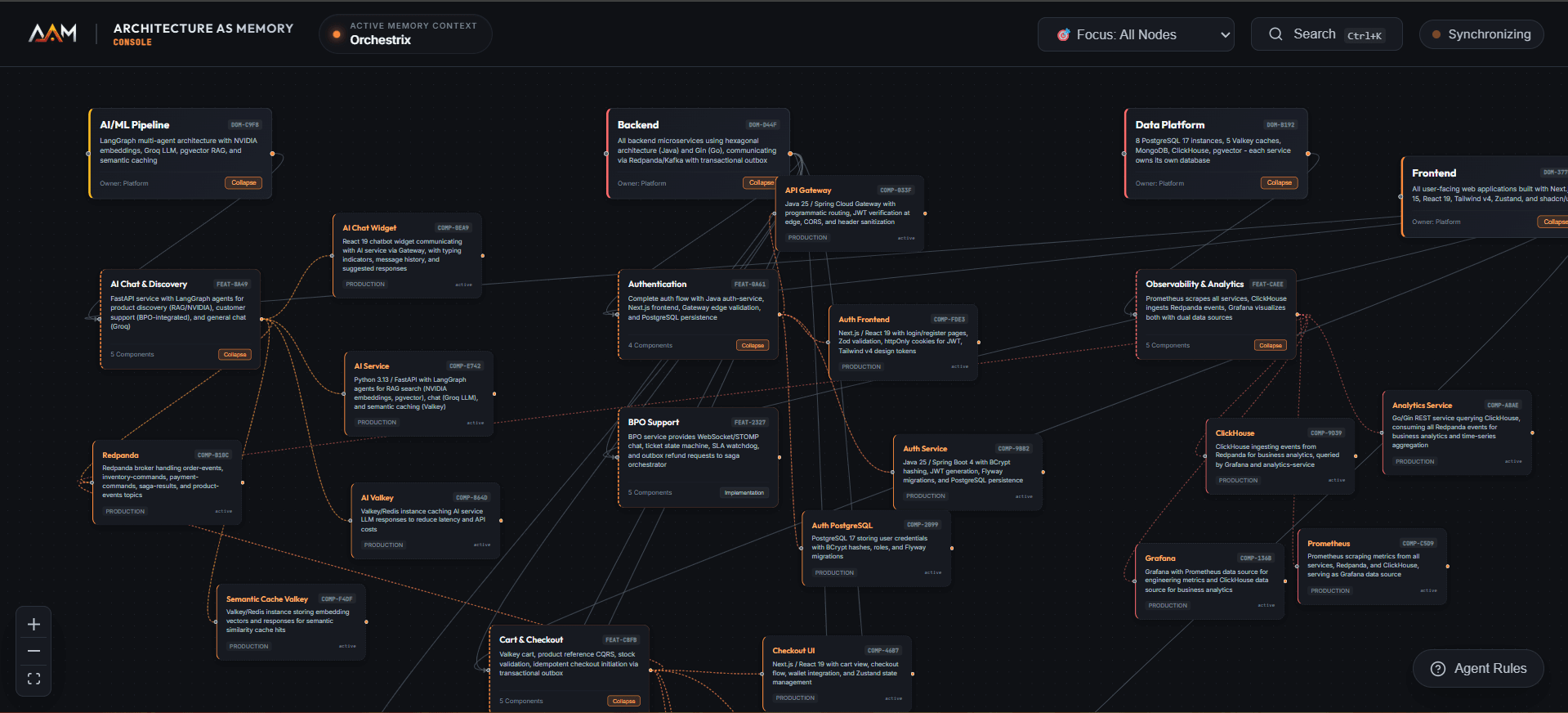
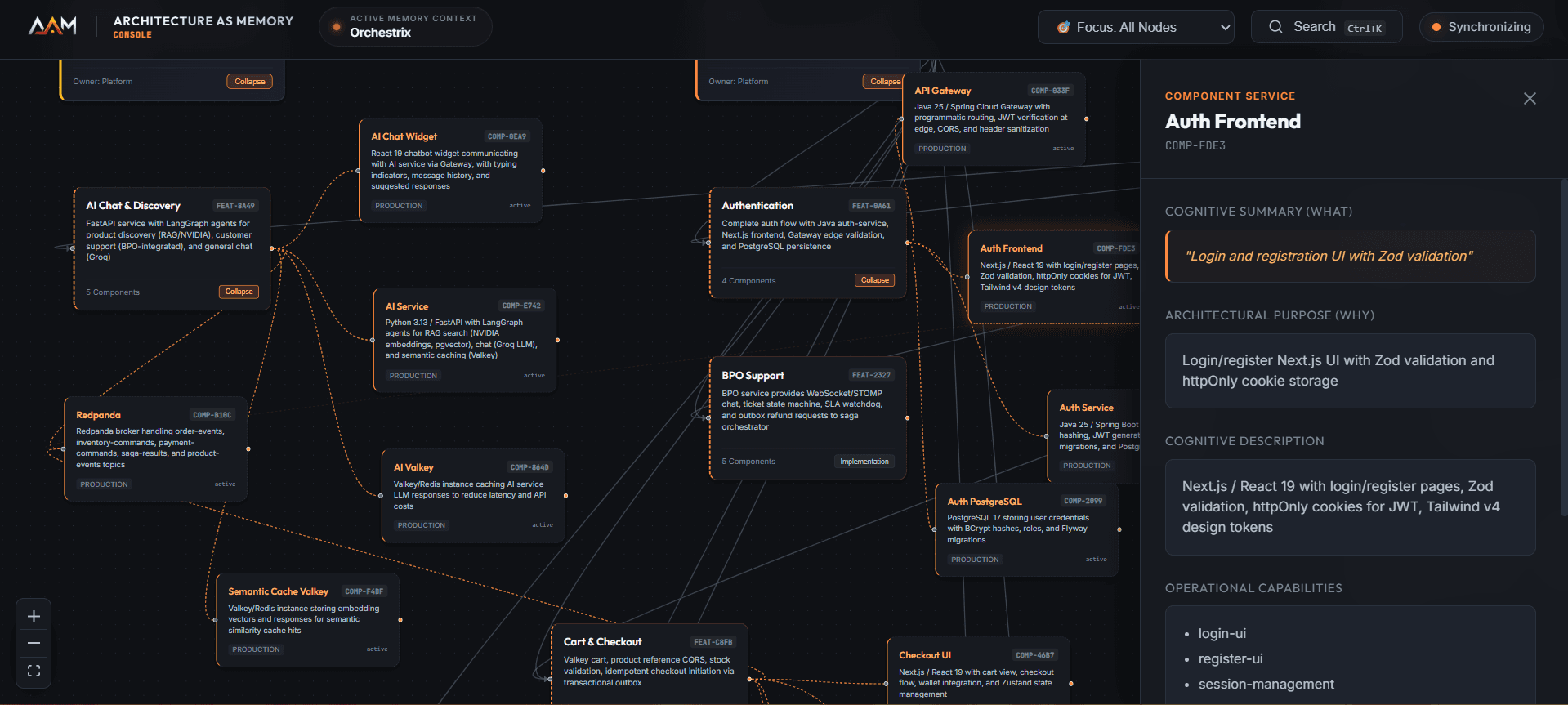
Layout connectors render only when parent domain modules are clicked, avoiding AST graph spaghetti.
Cognition-First: Architecture is Not Code Structure
Static structure tools display how directories are nested. AAM models how developers think, reason, and split system responsibilities.
Features Over Files
Humans reason in terms of business capabilities (e.g. user authentication, invoice processing) rather than nested index files or import statements.
Cognition Over AST
Raw AST scans generate spaghetti charts that overwhelm you. AAM keeps your graph clean and readable by grouping files inside functional components.
YAML Stability
Simple, local, human-readable YAML configurations serve as the sole source of architectural contracts. 100% resilient and offline-first.
Progressive Reveal
Maintain calm and clarity. Expand system modules and details contextually as you navigate rather than seeing the entire complexity at once.
Engineered CLI Lifecycle
Maintain your mental boundaries throughout the software lifecycle. Select a step to view output telemetry.
Securing AI Coding Agents via Governance Mappings
AAM embeds architecture guidelines directly into your agent instructions. Your agents read the rules offline and validate their mutations automatically.
Claude Code
Appends global structural system rules directly into CLAUDE.md, ensuring strict post-task verification loops.
Cursor Rules
Injects domain schemas directly into Cursor rules configuration file, guiding context selection and minimizing broken relationship changes.
Gemini CLI Rules
Configures system prompts and instructions on active workspace paths to maintain cognitive architecture bounds during chat iterations.
Git Hooks Protection
Protects git main branch pushes from architectural drifts by running validation tests in post-commit triggers.
Anchor Your System Cognition Today
Protect your mental models and maintain complete architectural clarity throughout your codebase iterations.